The coordination year
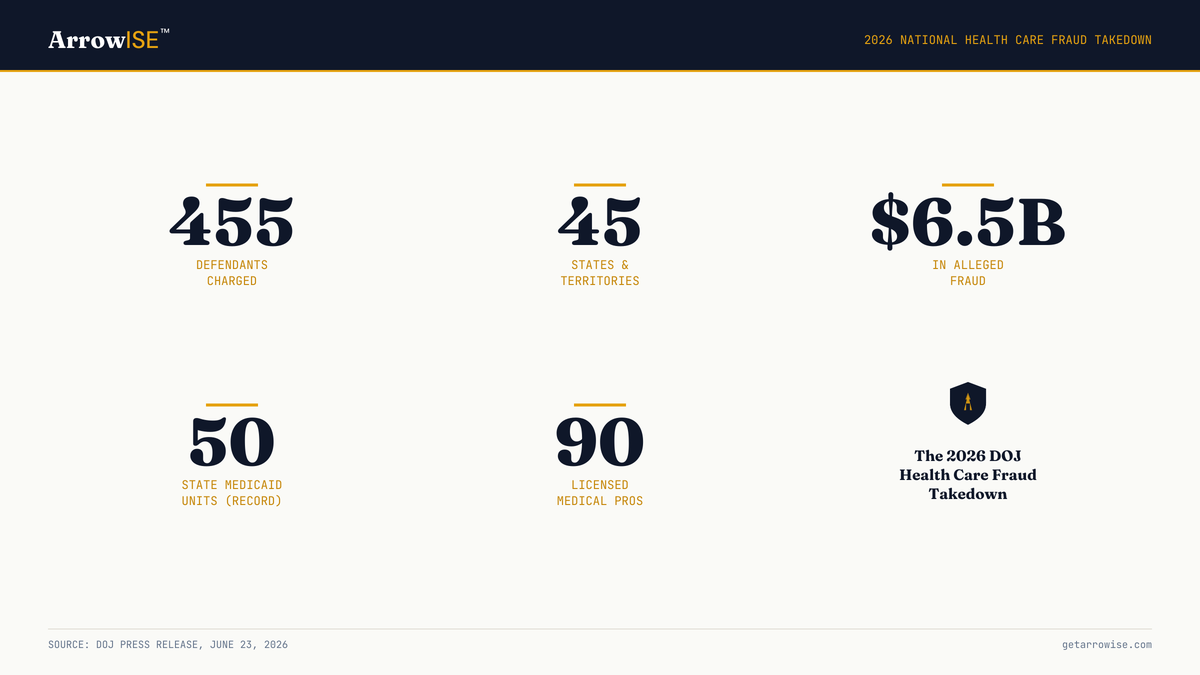
On June 23, 2026, the Department of Justice announced the 2026 National Health Care Fraud Takedown: 455 defendants charged across 56 federal districts and 45 U.S. states and territories, in connection with over $6.5 billion in alleged fraud. Ninety of the defendants were doctors or other licensed medical professionals. Fifty state Medicaid Fraud Control Units took part — the most in the department's history.
The defendant count is the headline. The coordination is the signal. A takedown that pulls in 50 state Medicaid Fraud Control Units and runs through a newly consolidated enforcement division is not an annual press event; it is a description of how federal and state fraud enforcement now operates by default. The numbers are large because the machinery producing them is larger than it used to be.
Outside counsel will publish detailed criminal-defense analysis of the announcement in the coming weeks. That is their expertise and their audience. Compliance officers reading this piece have a different question to answer — not how to defend against charges, but how to operate compliance programs that make charges implausible. This post is about that second question, and about the physician-compensation cases running underneath the takedown headline that speak to it directly.
The numbers that matter
Five figures are worth committing to memory. There were 455 defendants across 45 U.S. states and territories and 56 federal districts. Ninety were doctors or other licensed medical professionals. The alleged fraud exceeded $6.5 billion. And 50 state Medicaid Fraud Control Units participated, the most the department has ever assembled for a single action.
The Medicaid weighting is new. The 2026 takedown produced the largest number of Medicaid fraud defendants and the largest alleged Medicaid loss the department has ever charged — 295 defendants and more than $518 million. Set against fiscal year 2025's roughly $6.8 billion in False Claims Act recoveries, the picture is consistent: enforcement volume at historic capacity, sustained rather than spiking. This is what a routine enforcement year now looks like, and it is the baseline a compliance program is measured against.
The physician-compensation pattern
Most of the takedown's 455 defendants were charged in schemes that have little to do with a legitimate hospital's day-to-day: telemedicine allograft mills, phantom home-health billing, kickback rings targeting the homeless. But underneath the takedown headline runs a quieter, more relevant line of enforcement — matters that turn on how a lawful organization pays the physicians who refer to it.
On January 22, 2026, Traditions Health agreed to pay $34 million to resolve False Claims Act liability for medically unnecessary home-health billing and for paying remuneration to physician-medical-directors in Oklahoma and Texas who referred patients to it. Traditions self-disclosed the conduct and received cooperation credit — a reminder that the medical-directorship relationship remains a live enforcement target even when a program surfaces the problem itself.
Weeks later, Trinity Hospital in Steubenville, Ohio agreed to pay $1.7 million to resolve Stark Law allegations that, from 2014 through 2020, it rented office space from two referring physicians at rates exceeding fair market value. Trinity, too, self-disclosed. The common thread across both is not exotic: a financial relationship with a referral source that the organization could not fully defend on its documentation. The enforcement library catalogs the same pattern at larger scale — from Community Health Network to Halifax Health to Methodist Memphis.
The Erlanger signal
The case compliance programs should study longest is not in the takedown at all. In early 2026, a federal judge in the Eastern District of Tennessee denied Erlanger Health System's motions to dismiss — the government's suit on February 26 and the related whistleblower suit on March 9. The government alleges Medicare paid Erlanger roughly $27.8 million for services referred by employed physicians whose compensation exceeded fair market value and was designed around the value of their downstream referrals.
What makes Erlanger instructive is the defense that did not work at the motion stage. Erlanger had obtained outside fair-market-value opinions. But its own consultants had warned that projected compensation for certain physicians exceeded the 90th percentile of national data, that unusually high work-RVU levels raised risk, and that their fair-market-value conclusions were conditioned on documentation requirements the system did not enforce. The court let the case proceed.
The operational reading is factual, not editorial: an outside FMV opinion is a defense input, not a defense conclusion — and an opinion whose conditions go unmet is thinner still. That is the same point the April 2026 OIG FAQ update made from the regulatory side. Fair market value is necessary. It is not, by itself, sufficient.
The infrastructure signal
The takedown did not appear from nowhere. On April 7, 2026, the Department of Justice announced a National Fraud Enforcement Division, consolidating the Health Care Fraud Unit, the Tax Section, and the Market, Government, and Consumer Fraud Unit under a single division built to prosecute fraud against federal benefit programs. The 2026 takedown was that division's first major public showing.
Structural resourcing tends to translate, with a lag, into sustained recovery — the same dynamic visible in the fiscal year 2025 numbers. A consolidated division and 50 participating state Medicaid Fraud Control Units are not a one-year appetite; they are capacity that persists. For a compliance program, the relevant question is not whether enforcement is active. It is whether the program can demonstrate, arrangement by arrangement, that it would survive the kind of scrutiny this capacity produces.
What a five-year CIA now implies
Structural enforcement intensity has a downstream implication worth naming. Multi-statute settlements increasingly resolve into five-year Corporate Integrity Agreements. In 2025, Fresno-based Community Health System and its technology partner agreed to pay $31.5 million to resolve Anti-Kickback and Stark allegations — hospitality-lounge remuneration and electronic health record subsidies tied to referrals — and entered a five-year Corporate Integrity Agreement with HHS-OIG requiring, among other terms, a risk assessment. The full arrangement is in the enforcement library.
A CIA is not just a settlement line item. It is a five-year external overlay on the compliance program, including focused arrangements reviews — targeted examination of high-risk relationships with referral sources. Because CIAs increasingly define what regulators treat as a robust program, their expectations reach organizations that are not themselves under one. And the economics are one-directional: a compliance program built to withstand CIA-shaped review by design costs meaningfully less than a program rebuilt under CIA obligation after a settlement.
What compliance programs should do now
The 2026 environment rewards a specific posture: contemporaneous documentation, dual-statute analysis on every arrangement, fair market value opinions treated as inputs rather than dispositive defenses, and an audit trail that can prove it was not altered. None of that is new as principle. What the takedown and the Erlanger ruling change is the cost of not having it.
A practical starting point is bounded. Run a self-audit of the top physician arrangements: confirm FMV currency and that opinion conditions were actually enforced; verify every Stark exception element is documented and retrievable; confirm an independent Anti-Kickback intent analysis exists; check exclusion screening; and test whether the audit trail is tamper-evident. The seven-test compliance self-audit framework turns that into a four-hour diagnostic, and the free downloadable PDF version makes it a printable, fillable worksheet. For why the dual-statute standard changed, the Stark-versus-Anti-Kickback reference and the published defensibility methodology lay out the mechanics.
Outside counsel prepares defenses; compliance programs prevent the need for them. Both matter. This post is about the second.
The design partner cohort
The ArrowISE Design Partner Cohort is five hospital compliance programs building the infrastructure the 2026 enforcement standard now requires — fair market value currency and Stark elements scored, Anti-Kickback intent captured as a first-class field, exclusion screening on cadence, and a tamper-evident audit trail underneath all of it. It is compliance built to withstand a focused arrangements review by design rather than to scramble to one after a settlement.
Applications opened July 15, 2026, and the cohort begins August 15. It is a six-month working partnership with direct founder access and a reference commitment; conversion at cohort end is at a locked rate, 50% off the standard enterprise price. The full criteria and the application are on the design partner program page.
455 defendants across 45 states is not the anomaly. It is the operating environment. The design partner cohort is building compliance programs for it. Applications are open.